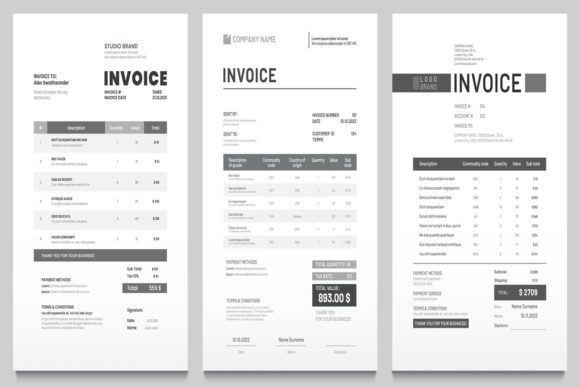
Streamline Your Finances with Professional Invoice Templates
For any business owner, freelancer, or creative professional, the moment you finish a project is satisfying, but the moment you get paid is essential. However, the paperwork between those two points often causes friction. A disorganized billing process can lead to delayed payments, confusion over terms, and a brand image that looks less than polished. This is where having a reliable system for your financial documents changes the game. Instead of scrambling to format a document in a word processor every time a job is done, using a structured set of Invoice Templates ensures consistency, professionalism, and speed.
The Anatomy of a Professional Billing Document
When we talk about a high-quality invoice bill template, we aren't just talking about a pretty piece of paper. We are talking about a functional tool designed to communicate clearly. A well-crafted template, such as the isolated vector set mentioned in the product file, serves as the backbone for several critical business interactions. It isn't just an invoice document page; it is a multi-purpose asset that can adapt to various financial needs.
Specifically, a robust template set usually encompasses more than just a standard bill. It often includes components for a price receipt, which serves as proof of transaction, and a payment agreement, which outlines the terms before work even begins. When these elements share a consistent design language, your business looks organized. The visual characteristics of these documents matter more than you might think. A clean layout with ample white space, clear typography, and logical grouping of data (like client details, itemized lists, and totals) reduces cognitive load for your client. They can see exactly what they owe and why without hunting for the information.
Visual Clarity and Brand Perception
Think of your billing documents as an extension of your brand identity. If you are a designer sending a chaotic, poorly formatted Excel sheet as an invoice, it contradicts the creative expertise you are selling. Conversely, a sleek, modern business sales pricing invoice reinforces your value. The "personality" of your financial paperwork should align with your service. If your brand is minimalist and modern, your invoice should reflect that through clean lines and sans-serif typography. If your brand is traditional and luxury, perhaps a serif font with elegant spacing is more appropriate.
The visual hierarchy is crucial here. Your client’s eye should naturally flow from the header (your logo) to the recipient, then to the itemized services, and finally to the bottom line. A professional accounting template utilizes size, weight, and color to guide this journey. When the visual structure is sound, it implies that your business logic is equally sound. It signals that you take your work—and their money—seriously.
Practical Applications Across Industries
You might wonder if a specific invoice bill template fits your niche. The beauty of a well-designed vector set is its versatility. Whether you are a contractor, a graphic designer, a retailer, or a consultant, the core need for clear communication remains the same.
- For Freelancers and Creatives: You need a document that balances professionalism with personality. Using a creative font for headers can add flair without sacrificing readability for the body text. This is where you turn a mundane administrative task into a subtle branding opportunity.
- For Small Businesses and Retail: Consistency is king. You might be issuing hundreds of price receipts a month. A template ensures that every customer receives the same high standard of documentation, which builds trust and makes your bookkeeping significantly easier.
- For Agencies and Consultants: Often, your billing involves retainers or complex payment agreements. A template allows you to clearly delineate phases of work, deposits, and final payments, reducing the likelihood of disputes later on.
Choosing the Right Design Assets
When selecting a template, you are essentially choosing design assets that will represent your company's financial face. It is worth taking the time to evaluate the file quality. A high-quality set often comes in formats like EPS (Encapsulated PostScript) or AI (Adobe Illustrator). Why does this matter? Because these are vector formats. Unlike a flat JPEG, a vector file allows you to scale the design to any size without losing quality. More importantly, it allows for deep customization.
Imagine you download a generic invoice, but the font clashes with your logo, or the color scheme doesn't match your website. If it’s a flat image, you are stuck. With a vector-based invoice document page, you can open it in software like Adobe Illustrator, ungroup the elements, change the color palette to match your brand guidelines, and swap the typeface to one that complements your existing materials. This level of control ensures that your business sales pricing invoices are not just generic forms, but tailored extensions of your marketing strategy.
Typography and Readability in Financial Documents
While we often discuss fonts in the context of logos or headlines, typography plays a massive role in accounting documents. The primary goal here is readability. You want a typeface that is legible at small sizes, especially for the itemized list of services or products.
A common approach in modern invoice templates is to pair a distinctive display font for the header with a highly readable sans serif font for the data. This creates a clear visual hierarchy. The header grabs attention and asserts your brand, while the body text provides the necessary details without causing eye strain. Avoid overly decorative script fonts for the actual numbers or terms; while they look beautiful on social media graphics, they can cause confusion when a client is trying to verify a dollar amount.
Furthermore, the layout of text blocks affects how quickly a bill gets paid. If the "Total Due" is buried in a wall of text or uses a font size that is too small, the client might miss it. Good modern typography in billing uses negative space to let the important figures breathe. This isn't just about aesthetics; it's about functional design that facilitates faster payment.
Customization and Editing
The instruction to use a vector editor like Adobe Illustrator is not just a technical note—it is a gateway to better branding. When you treat your invoice templates as editable design assets, you unlock the ability to create a cohesive ecosystem. You can ensure that the tracking of your letterforms (the spacing between letters) matches your other marketing materials. You can adjust the leading (line spacing) to make dense lists easier to scan.
This customization extends to the structure of the document itself. Perhaps you need to add a section for "Shipping and Handling" or a specific "Payment Agreement" clause. A rigid PDF won't let you do this easily. An editable template allows you to build a library of documents—a master invoice, a simplified receipt, and a detailed proposal—that all look like they belong to the same family. This consistency is a hallmark of a mature brand identity.
Streamlining Your Workflow
Ultimately, the goal of using these templates is to save you time and mental energy. By having a pre-designed, professional structure ready to go, you eliminate the "blank page syndrome" that often accompanies administrative tasks. You simply open your file, input the client's data, and send.
This efficiency allows you to focus on what you do best—whether that is logo design, editorial design, packaging design, or running your daily operations. It transforms the billing process from a chore into a seamless part of your client experience. When your financial documents are clear, professional, and easy to understand, you reduce back-and-forth emails and get paid faster. It’s a practical application of good design that has a direct impact on your bottom line.