Ready-to-Upload Notebook Templates for KDP: Your 12-Design Bundle
Let's be honest about the low-content publishing game. The idea of passive income from notebooks and journals is fantastic, but the reality often involves hours of tedious design work, endless research into popular formats, or the significant expense of hiring a designer for each new title. You know the drill: fiddling with margins, ensuring the line spacing is just right, and double-checking bleed settings for the tenth time. What if you could bypass that entire phase and move directly to publishing? That's the core value of a well-crafted set of Notebook Templates for KDP.
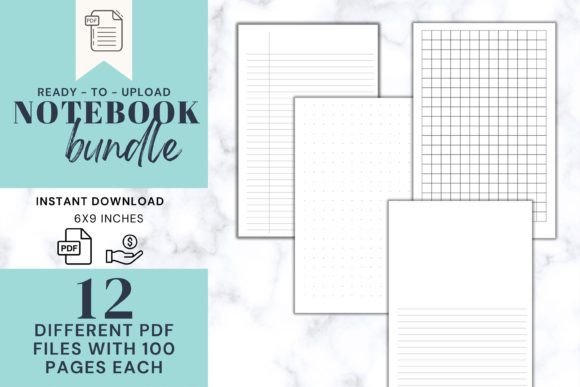
This particular bundle is built for the practical publisher. It’s not about flashy graphics or overly niche designs. It’s about providing a robust, ready-to-go foundation that covers the most in-demand notebook types on Amazon. Think of these templates as your design assets, a toolkit that saves you from the starting line. Each of the 12 designs is a complete, 100-page interior PDF formatted at the standard 6x9 inch size with no bleed, adhering to KDP's technical requirements. This isn't a mockup or a Canva link; it's the final file, ready for upload.
A Practical Look Inside the 12-Design Set
The strength of this collection lies in its variety and utility. Instead of a single style, you get a dozen distinct options, each targeting a specific user need. This allows you to publish multiple titles under one niche or test different formats to see what resonates with your audience. The designs are clean and functional, prioritizing usability over decorative flair, which is often what sells in this category.
Here’s what you’re getting:
- Classic & Academic: College Ruled, Wide Ruled, and Half College are your bread-and-butter for students, professionals, and everyday note-takers. They are the sans serif fonts of the notebook world—universally understood and reliably functional.
- Creative & Specialized: Dot Graph, Graph Paper, Hexagon, and Half Graph cater to designers, architects, bullet journalers, and anyone who needs structured yet flexible layouts. These are the display font equivalents, offering a distinct personality for a targeted audience.
- Artistic & Personal: Sketch Book, Journal, and Handwriting templates serve artists, diary keepers, and those seeking a more personal, handwritten font style experience without the ink bleed-through issues of actual handwriting.
- Hybrid & Modern: Half Wide/Graph is a smart hybrid, perfect for users who want to combine notes with small sketches or diagrams, reflecting a modern approach to organization.
Each template maintains a consistent, professional standard. The margins are properly set, the line weights are appropriate for print, and the overall layout ensures a pleasant writing or drawing experience. This attention to the unglamorous details is what separates a professional publication from an amateur one, directly impacting your brand identity as a publisher.
Where These Templates Shine: Beyond Basic Notebooks
While the primary use is creating low-content books for Amazon KDP, the applications of these Notebook Templates for KDP extend further. For entrepreneurs and small business owners, they can be transformed into branded company journals, meeting notebooks, or client gifts. A marketing agency could use the Dot Graph template as a premium giveaway for brainstorming sessions, subtly reinforcing their brand's creative and organized persona.
For bloggers and content creators, these templates are a launchpad for companion products. A food blogger might use the Journal template to create a recipe log, while a fitness influencer could adapt the Half Graph template for workout planning. The templates act as a foundational design asset, which you can then customize with a unique cover that reflects your personal or commercial brand. This approach ensures consistency across your product line, strengthening audience recognition.
Even for personal use, the value is clear. Crafters and hobbyists can print a single copy of the Sketch Book or Hexagon template for their own projects, enjoying a professionally laid-out notebook without the cost of a mass-produced one. It’s a practical solution for prototyping ideas or simply enjoying a high-quality tool for your hobbies.
Choosing and Using Your Templates Effectively
Having a bundle is one thing; using it strategically is another. Here’s how to approach these Notebook Templates for KDP like a seasoned publisher.
1. Evaluate the Niche Fit: Don't just upload all twelve at once. Research current trends. Is there a surge in interest for hexagonal grid journals for RPG mapping? Is the bullet journal community still thriving, making Dot Graph a solid bet? Align your publishing calendar with real demand. This is where your role shifts from designer to strategist.
2. The Power of the Cover: The interior is handled, so your creative energy should focus 100% on the cover. This is your primary tool for visual hierarchy and grabbing attention in search results. A great cover on a simple College Ruled notebook can outsell a mediocre cover on a niche design. Think about font pairing here—choose a premium font for your title that complements the clean interior and resonates with your target audience.
3. Branding for Consistency: If you plan to publish a series, use a consistent cover design style. For example, use the same script font or serif font for all titles in a "Creative Professional" series, varying only the color or a small icon. This builds a recognizable brand identity that encourages repeat purchases from customers who liked your first notebook.
4. Test Before You Scale: While the templates are ready, it's always wise to order a single proof copy. Check the paper weight interaction with your chosen interior (though the PDFs are optimized for standard print). Ensure the line spacing feels right in physical form. This small step upholds professionalism and prevents negative reviews about usability.
5. Commercial Mindset: Remember, these are commercial font style assets for creating products. You're not just making a notebook; you're building a micro-brand on Amazon. Each listing should have a clear, benefit-driven title and description that speaks directly to the user's needs—whether it's "for architects" or "daily gratitude journal."
In the end, the goal of this bundle is to remove friction. It provides the reliable, well-designed interior that forms the backbone of a successful low-content book. By saving you dozens of hours on layout and design, it allows you to focus on what truly drives sales: smart niche selection, compelling branding, and effective marketing. You're not just buying PDFs; you're investing in a faster, more efficient publishing workflow.